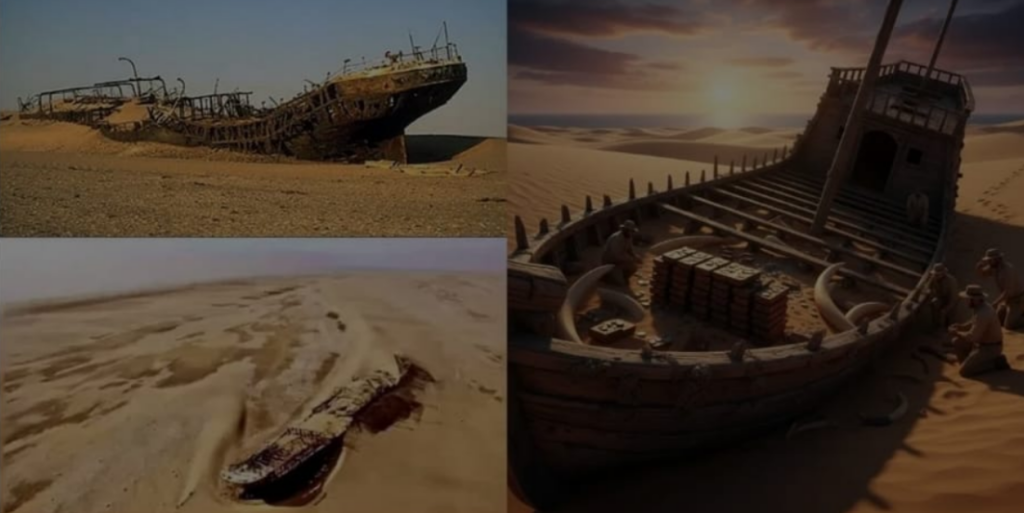
Imagine a massive ship buried in the sand in the middle of a vast desert. It sounds like something out of a Hollywood science fiction movie, doesn’t it? But this actually happened in the Namib Desert of Africa.
Beneath the sand dunes stretching along the Atlantic coast, a ‘golden ship’ that had been dormant for 500 years astonished the world. In 2008, while researchers were pumping out seawater and excavating the land for diamond mining off the coast of Namibia, they were stunned to discover the wreckage of an old wooden ship. Further investigation revealed it to be the ‘Bom Jesus,’ a Portuguese merchant ship that disappeared in 1533.
What was inside the ship?
When the wooden planks of the ship were carefully removed, dazzling treasures were revealed:
2,000 gold coins: Their luster remained undiminished even after so many centuries.
Tons of copper ingots: Countless silver coins were also found.
Elephant tusks: Rare elephant tusks, collected during a trading voyage to Asia, were found intact.
How did the ship end up in the desert? In 1533, this ship set sail towards India on the orders of the King of Portugal to purchase spices such as pepper. However, en route, it was caught in a terrible storm in the Atlantic Ocean, struck rocks, and was wrecked. Over time, due to changes in sea level and wind direction, the area became separated from the sea and transformed into a desert. As a result, the ship was safely buried in the sand.
What happened to the 200 soldiers? – An Unsolved Mystery!
There is one aspect of this discovery that is deeply unsettling. Approximately 200 soldiers should have been traveling on this ship. However, not a single human skeleton was found at the site where the ship was discovered. Did they all drown in the sea? Or did they reach the shore and struggle to survive in this desert? This remains an unresolved mystery to this day. The Portuguese government handed over all the treasures found in the ship to Namibia. The ‘Bom Jesus’ is not just an old ship; it is a testament to the adventurous voyages undertaken by humans across the seas 500 years ago!







vsdgo2