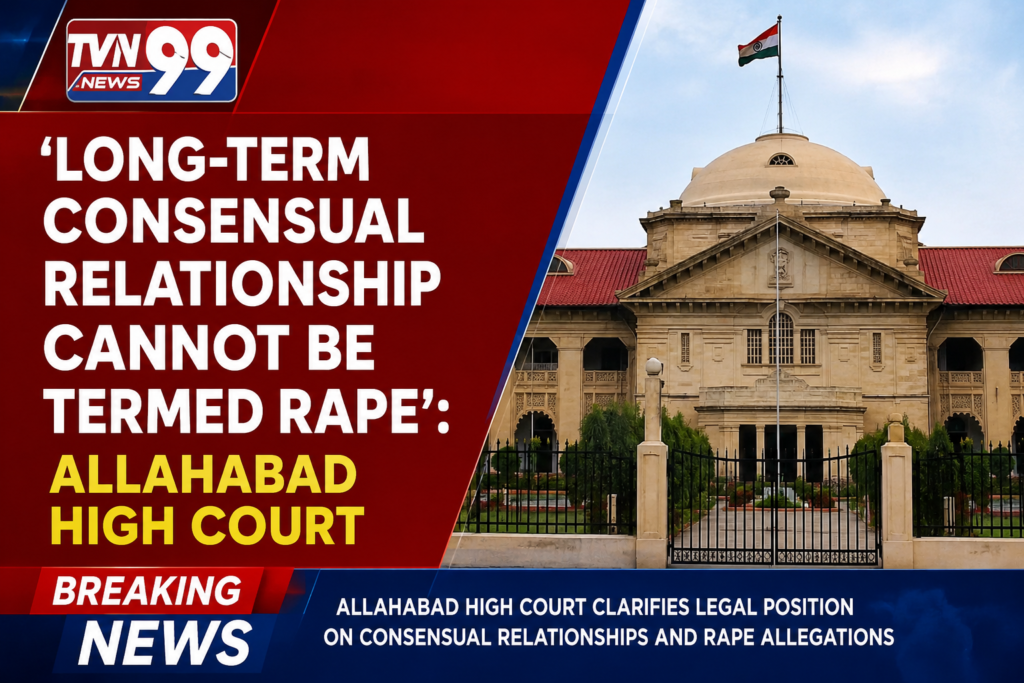
Allahabad High Court Rules That a Long-Term Consensual Relationship Does Not Automatically Amount to Rape
The Allahabad High Court has observed that a long-term consensual relationship between two adults cannot be categorized as rape solely because the relationship later ends or fails to culminate in marriage. The ruling has reignited discussions around consent, personal relationships, and the distinction between breach of promise and criminal liability under Indian law.
The court emphasized that when two consenting adults voluntarily engage in a relationship over an extended period, allegations of rape must be carefully examined in light of the facts and circumstances surrounding the case.
Key Highlights of the Allahabad High Court Judgment
- The court noted that a prolonged consensual relationship does not automatically constitute rape.
- Consent given by an adult in a relationship must be assessed based on the specific facts of the case.
- A failed relationship or broken promise of marriage does not necessarily translate into a criminal offense.
- Courts must distinguish between genuine cases of sexual exploitation and consensual relationships that later deteriorate.
The judgment highlights the importance of evaluating whether consent was obtained through deliberate deception from the very beginning or whether the relationship was genuinely consensual.
Understanding the Legal Context
Under Indian law, allegations of rape based on a promise of marriage often require courts to determine whether the promise was made in bad faith with the sole intention of obtaining consent for sexual relations.
Legal experts frequently point out that:
- If a promise of marriage was never intended to be fulfilled and was used to deceive a person into consenting, criminal liability may arise.
- However, if both parties willingly entered into a relationship and the marriage could not take place due to subsequent circumstances, it may not automatically amount to rape.
The Allahabad High Court’s observations reinforce this distinction.
Why This Judgment Matters
The ruling is significant because it addresses a growing number of cases where relationships that began consensually later result in criminal complaints after disputes, separation, or failed marriage plans.
Legal observers believe the judgment may:
- Provide greater clarity on the interpretation of consent.
- Help courts differentiate between consensual relationships and criminal misconduct.
- Reduce misuse of criminal provisions in cases arising from failed relationships.
- Encourage a fact-based approach when evaluating allegations involving promises of marriage.
Impact on Future Cases
The Allahabad High Court’s observations could influence how lower courts examine similar cases involving allegations arising from long-term relationships.
Future cases are likely to focus on:
- The nature and duration of the relationship.
- Evidence of consent.
- Intentions of the parties at the beginning of the relationship.
- Whether any fraudulent misrepresentation was involved.
Courts may continue to emphasize that every case must be decided on its own facts rather than applying a blanket legal interpretation.
Public Reactions and Legal Debate
The judgment has sparked discussions among legal professionals, women’s rights advocates, and civil society groups. While some view the ruling as a necessary safeguard against the criminalization of failed relationships, others stress the need to ensure that genuine victims of deception and exploitation continue to receive legal protection.
The debate underscores the evolving nature of consent jurisprudence in India and the challenges courts face in balancing individual rights with protections against abuse.
Conclusion
The Allahabad High Court’s observation that a long-term consensual relationship cannot automatically be termed rape reinforces the legal distinction between consensual adult relationships and criminal acts. The ruling highlights the importance of examining intent, consent, and the specific circumstances of each case before arriving at a legal conclusion.
As courts continue to address complex cases involving promises of marriage and consent, this judgment is likely to remain an important reference point in India’s evolving legal landscape.