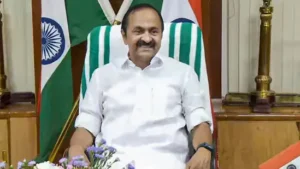
KC Venugopal, Cong general secretary (organisation), was a frontrunner when CM race started with three contenders, other two being Satheesan and Chennithala.
Soon after VD Satheesan was sworn in as Kerala’s 13th chief minister, Congress leader Rahul Gandhi posted a message on X that ran to about six sentences, and mentioned two people by name.
“Warm congratulations to VD Satheesan ji and the entire cabinet, who will now represent the voice of every Keralite,” Gandhi wrote. “Thanks to KC Venugopal ji, who led this campaign from the frontlines,” he added. Satheesan got compliments. Venugopal got gratitude. The photo collage in the post had Rahul hugging both, and others.
The Congress-led United Democratic Front won 102 of Kerala’s 140 assembly seats in the April 9 election, results for which came on May 4. The Congress alone won 63 seats. The Left Democratic Front, which had held power for a decade, was reduced to 35. The BJP won three.
What followed was 10 days during which no chief minister was named by the Congress.
How CM race panned out
KC Venugopal, the party’s national general secretary (organisation) and Lok Sabha MP from Alappuzha in Kerala, was a frontrunner as the race began with three contenders, the other two being Satheesan and Ramesh Chennithala.
At one point, seven of 10 senior Kerala Congress leaders consulted by the party high command, meaning the Gandhi family and president Mallikarjun Kharge, backed Venugopal. Kharge and Rahul Gandhi held the final call.
On May 15, the party announced Satheesan, Leader of the Opposition in the outgoing assembly, as its choice. This, after a half-and-half power-sharing arrangement for the CM’s post between Venugopal and Satheesan was floated and rejected, HT has reported. The party was wary of such an arrangement becoming a chief distraction like in Chhattisgarh and Karnataka.
No deputy CMs have been announced for the new Kerala government so far. Ramesh Chennithala is part of Satheesan’s cabinet.
The weeks between the result and the swearing-in produced visible public friction too. Supporters of rival leaders took to the streets across districts. Posters were pulled down. The Congress leadership had to manage internal dissent while simultaneously negotiating with coalition partners over cabinet seats.