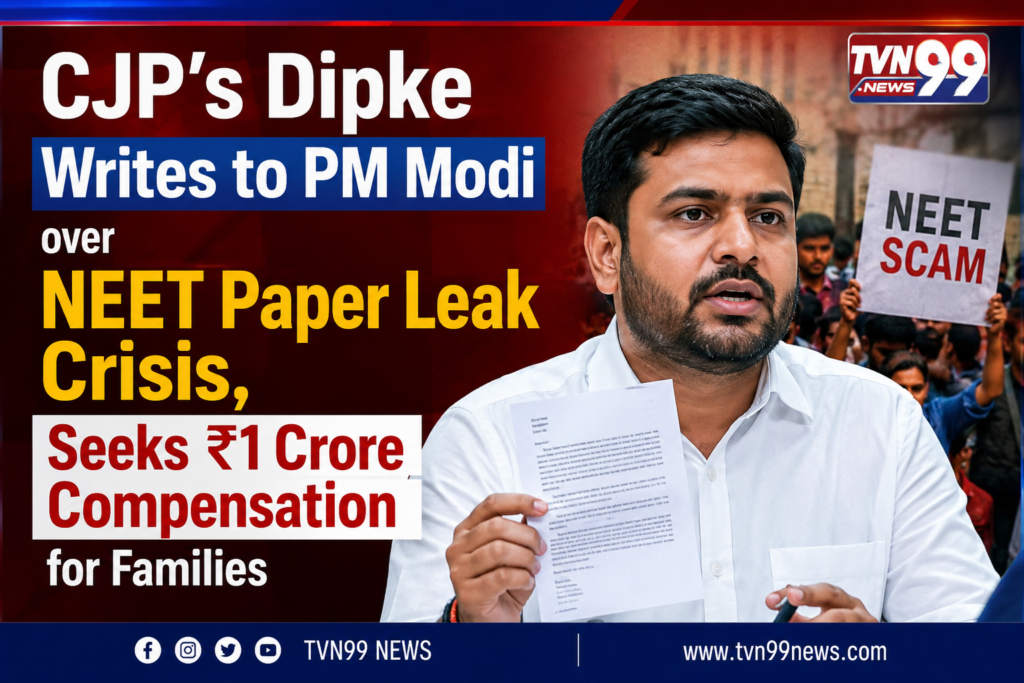
Amid growing outrage over the alleged NEET 2026 paper leak controversy, Cockroach Janata Party (CJP) founder Abhijeet Dipke has written an open letter to Prime Minister Narendra Modi, demanding immediate intervention and accountability in what he described as a crisis that has shaken the confidence of millions of students and parents across India.
In the letter, Dipke called for ₹1 crore compensation to be provided to the families of students who allegedly lost their lives due to stress and uncertainty linked to examination irregularities. He argued that the emotional and psychological impact of repeated paper leak incidents has severely affected the country’s youth and undermined trust in the education system.
Key Demands Raised by CJP
According to the open letter, Dipke urged the central government to take urgent steps to restore credibility to India’s examination process. Among the major demands were:
- ₹1 crore compensation for families of students allegedly affected by the crisis.
- Greater transparency in investigations related to the NEET paper leak.
- Strong accountability measures against officials responsible for examination lapses.
- Comprehensive reforms to prevent future examination irregularities.
- Immediate action to rebuild trust among students and parents.
Growing Pressure Over NEET Controversy
The NEET paper leak issue has triggered nationwide protests, student demonstrations, and political criticism. Several student groups and activists have questioned the security measures adopted during the examination process and demanded stricter safeguards against malpractice.
Dipke has emerged as one of the most vocal critics of the government’s handling of the controversy, previously organizing protests and campaigns calling for accountability within the education system. He has repeatedly stated that students should not bear the consequences of administrative failures.
Concerns Over Student Mental Health
A major focus of Dipke’s appeal is the mental health impact on students. The uncertainty surrounding examination cancellations, re-examinations, and alleged paper leaks has reportedly created significant stress among aspirants preparing for highly competitive entrance exams.
Education experts have also emphasized the need for transparent communication and swift resolution of examination disputes to prevent further anxiety among students. The controversy has reignited discussions about examination reforms and the need for stronger institutional safeguards.
Calls for Education System Reforms
The latest letter adds to a growing chorus of voices demanding reforms in India’s examination ecosystem. Stakeholders have called for enhanced cybersecurity measures, stricter monitoring mechanisms, and independent audits of examination processes to ensure fairness and integrity.
As the debate continues, attention remains focused on the government’s response and the measures that may be introduced to restore confidence in one of India’s most important entrance examinations.
Conclusion
The NEET paper leak controversy has evolved into a broader discussion about accountability, student welfare, and the future of India’s examination system. With CJP founder Abhijeet Dipke’s latest appeal to Prime Minister Narendra Modi, pressure is mounting on authorities to address concerns, deliver justice, and implement long-term reforms that protect the aspirations of millions of students nationwide.