India’s Naval Power Gets a Major Boost with Three New Warships
India has taken a significant step toward strengthening its maritime security and expanding its defense capabilities with the induction of three advanced naval platforms into the Indian Navy. The latest fleet expansion reflects India’s commitment to modernizing its naval forces, enhancing maritime surveillance, and securing strategic interests across the Indian Ocean Region (IOR).
With each vessel designed for a specialized mission, the new additions represent a balanced approach to naval warfare, coastal defense, and maritime operations. Here’s a closer look at how these three ships are set to transform India’s naval capabilities.
Why India’s Naval Expansion Matters
As geopolitical tensions continue to evolve in the Indo-Pacific region, naval dominance has become a critical factor in maintaining national security. India faces growing challenges ranging from maritime piracy and territorial disputes to increased naval activity by regional powers.
The induction of these vessels demonstrates India’s focus on:
- Strengthening maritime security
- Enhancing operational readiness
- Protecting critical sea lanes
- Expanding blue-water naval capabilities
- Supporting indigenous defense manufacturing
The move aligns with the government’s vision of creating a self-reliant defense ecosystem under the “Aatmanirbhar Bharat” initiative.
Ship One: Advanced Guided Missile Destroyer
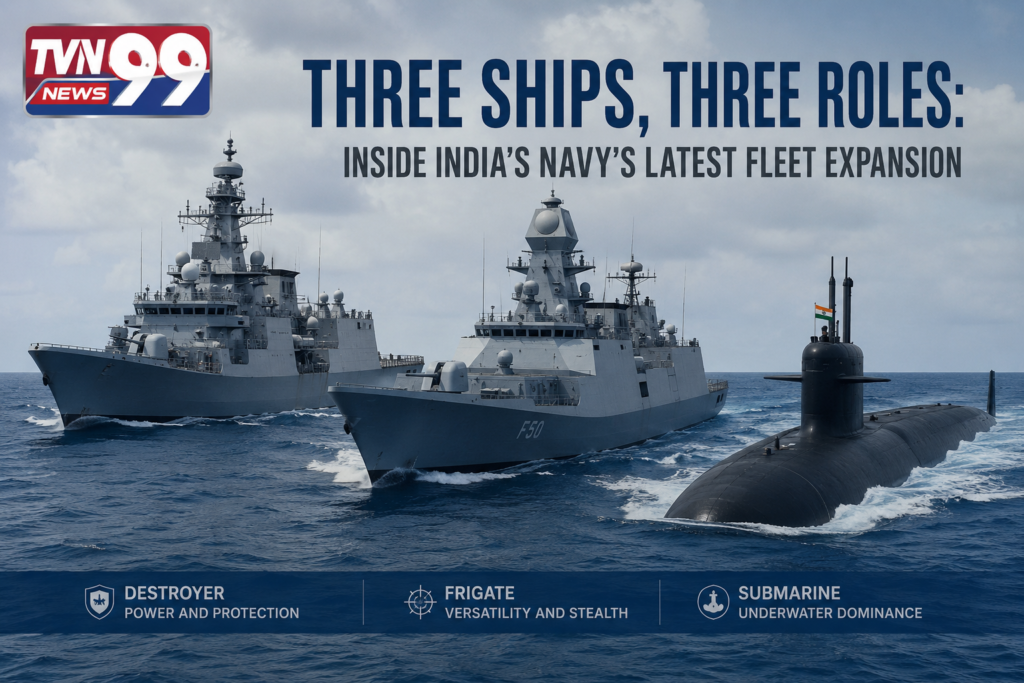
The first addition to the fleet is a state-of-the-art guided missile destroyer equipped with advanced radar systems, anti-aircraft capabilities, and long-range strike weapons.
Key Features
- Multi-role combat capability
- Advanced missile defense systems
- Long-range surveillance radar
- Anti-submarine warfare technology
- Network-centric combat operations
Strategic Role
This destroyer will serve as a frontline combat vessel capable of protecting carrier battle groups, conducting offensive operations, and responding to regional security threats.
Its deployment significantly enhances India’s ability to project power across the Indian Ocean and beyond.
Ship Two: Stealth Frigate for Modern Naval Warfare
The second vessel is a stealth frigate designed to operate with a reduced radar signature, making it harder for adversaries to detect and track.
Key Features
- Stealth technology
- Integrated combat management systems
- Advanced anti-ship missiles
- Electronic warfare capabilities
- Multi-domain operational flexibility
Strategic Role
Stealth frigates play a crucial role in escort missions, maritime interdiction, intelligence gathering, and coastal defense operations.
The vessel is expected to improve India’s ability to conduct high-risk missions while maintaining operational secrecy.
Ship Three: Submarine for Underwater Dominance
The third addition focuses on underwater warfare capabilities. Modern submarines remain among the most effective deterrents in naval strategy due to their stealth and strike potential.
Key Features
- Enhanced underwater endurance
- Advanced sonar systems
- Torpedo and missile launch capability
- Low acoustic signature
- Intelligence and surveillance functions
Strategic Role
The submarine strengthens India’s underwater warfare capabilities, helping maintain a credible deterrence posture while monitoring strategic maritime routes.
Its presence adds a crucial layer of defense against potential underwater threats.
Strengthening India’s Position in the Indo-Pacific
The Indo-Pacific region has emerged as one of the world’s most strategically important maritime zones. With global trade heavily dependent on sea routes, securing these waterways has become a top priority for major nations.
India’s latest naval expansion supports:
- Freedom of navigation
- Regional stability
- Maritime domain awareness
- Humanitarian assistance and disaster relief missions
- Joint naval exercises with allied nations
These capabilities enhance India’s role as a net security provider in the region.
Indigenous Defense Manufacturing Takes Center Stage
One of the most notable aspects of the fleet expansion is the increasing contribution of India’s domestic defense industry.
Many critical systems used in modern naval platforms are now being developed and manufactured within the country, reducing reliance on foreign suppliers and boosting technological self-sufficiency.
This advancement supports:
- Local job creation
- Defense exports
- Technological innovation
- Long-term strategic independence
The success of indigenous shipbuilding programs highlights India’s growing expertise in naval engineering and defense production.
Future Outlook for the Indian Navy
The induction of these three vessels is only part of a broader modernization roadmap. The Indian Navy continues to invest in:
- Aircraft carriers
- Next-generation submarines
- Unmanned maritime systems
- Advanced surveillance networks
- Artificial intelligence-enabled defense technologies
As maritime competition intensifies globally, India is positioning itself to meet emerging security challenges with a technologically advanced and combat-ready naval force.
Conclusion
The addition of three specialized warships marks a significant milestone in India’s naval modernization journey. Each vessel brings unique capabilities to the fleet, collectively enhancing the Navy’s ability to defend national interests, secure critical maritime routes, and respond to evolving threats.
As India continues to expand its maritime footprint, these new ships symbolize not only military strength but also the nation’s growing confidence as a leading power in the Indo-Pacific region.