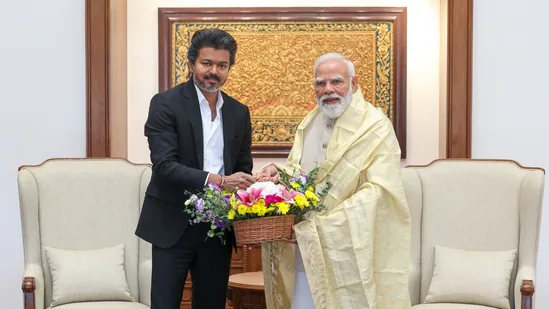
After Tamil Nadu CM Vijay met PM Modi in Delhi, he also visited the Tamil Nadu House in Delhi, where he was accorded a guard of honour.
After Tamil Nadu CM Vijay met PM Modi in Delhi, he also visited the Tamil Nadu House in Delhi, where he was accorded a guard of honour.
“Chief Minister of Tamil Nadu, Thiru @actorvijay met Prime Minister @narendramodi today,” the Prime Minister’s office posted on ‘X’.
The meeting lasted around 30 minutes, sources told HT.
During his visit, Vijay also visited the Tamil Nadu House in Delhi, where he was accorded a guard of honour.
Sources said the chief minister is expected to meet Vice President CP Radhakrishnan, Union home minister Amit Shah and finance minister Nirmala Sitharaman during his trip, according to ANI.
He is also scheduled to meet senior Congress leaders, including Sonia Gandhi, Rahul Gandhi and Mallikarjun Kharge, at 10 Janpath, said the report. Posters featuring Rahul Gandhi and Vijay were seen outside the residence.
This marks Vijay’s first official visit to the national capital since securing a trust vote on May 13 with the backing of Congress, CPI, CPI(M), VCK and IUML legislators.
What all did Vijay discuss with PM Modi?
During his meeting with PM Modi, CM Vijay raised a range of issues concerning defence projects, federal rights, education, fisheries and pending financial allocations to the state, according to Tamil Nadu government release.
Below is the list of issues discussed:
1. Vijay informed the Prime Minister that major defence initiatives such as the Advanced Medium Combat Aircraft (AMCA) project and the Combat Airborne Systems (CABS) project are already being implemented in Tamil Nadu with the involvement of several DRDO-linked organisations. He urged the Centre to establish the Combat Airborne Systems facility in the state as a continuation of these projects.
2. The chief minister also pressed for the implementation of the Cauvery Water Disputes Tribunal order regarding the constitution of the Cauvery Management Board, saying delays by the Union government were adversely affecting farmers and people dependent on Cauvery water.
3. On education, Vijay reiterated Tamil Nadu’s long-standing demand for exemption from NEET, stating that despite the Assembly passing legislation twice, the Centre had not accepted the request. He argued that the examination disproportionately affects students from rural and economically weaker backgrounds.
4. The issue of Tamil Nadu fishermen being arrested by the Sri Lankan Navy was also raised, with Vijay urging the Centre to pursue diplomatic measures for a permanent solution. He further expressed concerns over the National Education Policy and what he described as the imposition of Hindi, saying it was affecting Tamil linguistic rights.
5. Vijay also sought the immediate release of pending funds and approvals for several state schemes delayed by the Union government.