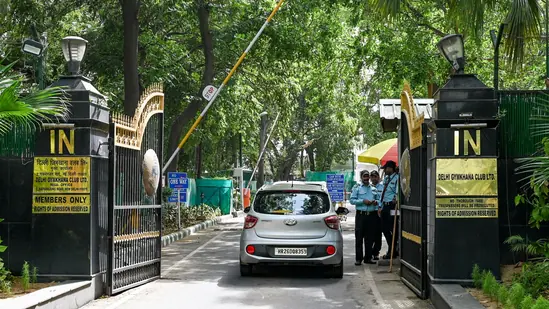
The high court declined to immediately restrain the Centre from taking further action in pursuance of its notice directing the Delhi Gymkhana Club to vacate.
Centre told the Delhi high court on Tuesday that it has given the Delhi Gymkhana Club, or DGC, an opportunity to vacate the premises “on its own” and that if they do not vacate on their own, it is not that the police will rush in and the Centre will take forcible possession of the premises.
Solicitor General Tushar Mehta told the high court that possession will be taken in accordance with the law.
“We cannot go and get it vacated,” he told the single-judge bench of justice Avneesh Jhingan.
“We will not take possession except in accordance with the procedure as per law. It cannot be on the 5th, because we will have to issue notice, etc. It’s not that on the 5th, somebody will grant consent,” the law officer further said.
This comes after the Centre asked the Gymkhana Club in Lutyens’ Delhi to hand over its premises by June 5, citing that the 27.3-acre land parcel was required for “strengthening and securing defence infrastructure”.
The high court declined to immediately restrain the Centre from taking further coercive action pursuant to its notice, noting its submission that it would not take “immediate possession” of the property and that any action would be carried out in accordance with law.
“Taking into account the summons have been issued, and in view of the statement made by the SG, no further interim directions are called for, and at the cost of repetition, the statement is to the effect that the eviction, if so, will be as per law following a prior notice,” justice Jhingan said in the order.
Established in 1913, the Delhi Gymkhana Club was described by its members as one of the capital’s oldest sporting and social institutions, with heritage value beyond its commercial land value.
What is the Delhi Gymkhana row?
The order, issued by the Land & Development Office (L&DO) under the Union Housing and Urban Affairs Ministry, stated that the premises, located in a highly sensitive and strategic area of Delhi, are critically required for the strengthening and securing of defence infrastructure and for other vital public security purposes.